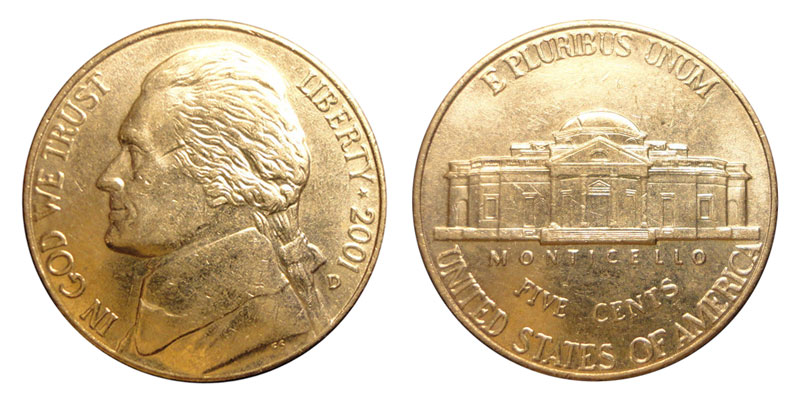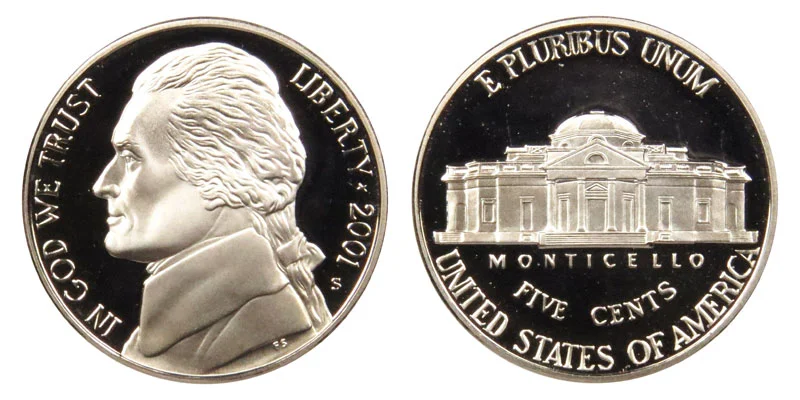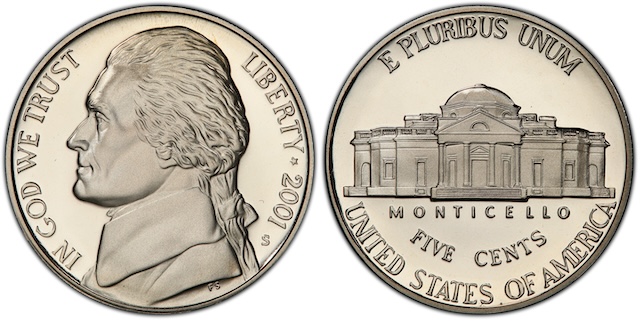
A 2001-D Jefferson nickel graded MS67 Full Steps sold for $823 at Heritage Auctions in February 2017. Most 2001 nickels circulating today are worth face value, but the right combination of mint mark, strike quality, and condition can transform an ordinary pocket coin into a serious collectible.
Use the free tools below to find out exactly where your coin falls — whether it's a standard circulated piece, an uncirculated gem, or one of the coveted Full Steps examples that command real collector premiums.
Select your mint mark, condition, and any errors below to get an instant value estimate for your 2001 Jefferson nickel.
If you're not sure what mint mark or condition your coin is, there's a 2001 Nickel Coin Value Checker free tool that lets you upload a photo and get an AI-powered estimate without needing to know those details first.
Not sure about your coin's exact grade? Describe what you see and our analyzer will interpret your description and suggest a value range.
Get an instant value estimate for your 2001 nickel — just pick your mint mark and condition.
Use the Free Calculator →The Full Steps (FS) designation is the single biggest value driver for 2001 Jefferson nickels. A coin that qualifies can be worth 3–10× more than the same grade without it. Use this checker to assess yours.
For a complete illustrated step-by-step 2001 nickel identification and grading reference, the CoinValueApp guide includes photo comparisons for each grade tier. The table below summarizes current market values by variety and condition based on PCGS and Heritage auction data.
| Variety | Worn (G–F) | Circulated (AU) | Uncirculated (MS60–65) | Gem (MS66+) |
|---|---|---|---|---|
| 2001-P Standard | $0.15 | $0.60 – $0.90 | $1 – $41 | $41 – $120 |
| 2001-P Full Steps ⭐ | $0.15 | $0.60 – $0.90 | $1 – $60 | $60 – $2,570 |
| 2001-D Standard | $0.15 | $0.60 – $0.90 | $1 – $20 | $20 – $50 |
| 2001-D Full Steps 🏆 | $0.15 | $0.60 – $0.90 | $1 – $100 | $100 – $823+ |
| 2001-S Proof DCAM | — | — | — | $2 – $23 |
⭐ = Signature variety (Full Steps premium). 🏆 = Rarest/highest recorded sale. Values based on PCGS/Heritage auction data; individual sales vary by grade, eye appeal, and market timing.
🪙 CoinKnow lets you photograph your 2001 nickel and instantly estimate its grade tier and value range — a coin identifier and value app for quick on-the-go assessments.
Jump to any section using the links below.
Error coins from the 2001 Jefferson nickel series are genuine manufacturing defects that escaped quality control at the Philadelphia and Denver mints. Each error type creates a visually distinct and collectible anomaly. The variety cards below cover the most sought-after error types, their diagnostic features, and what serious collectors pay for them. Use the sidebar to jump to a specific variety.
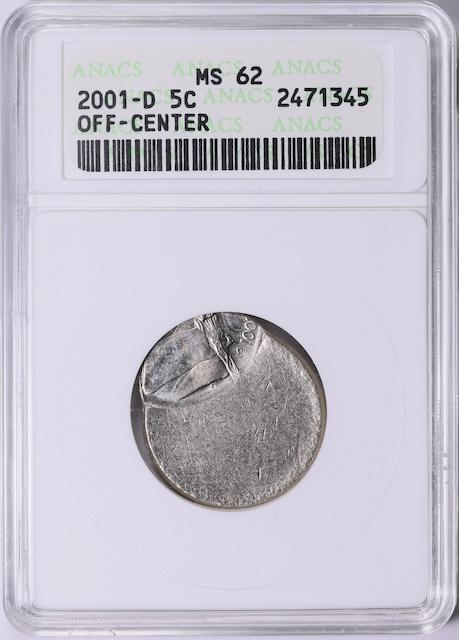
An off-center strike occurs when the planchet is not properly centered beneath the dies at the moment of striking. The result is a coin where the design is shifted to one side, leaving a blank, unstruck crescent visible on the opposite edge. This is among the most visually dramatic errors a collector can find in pocket change.
The degree of misalignment is measured as a percentage. A 5% off-center coin shows minimal displacement with the date barely visible at the edge; a 50% off-center coin has half its design missing, replaced by a broad blank field. For 2001 nickels, the sweet spot for collectors is 10–30% off-center — dramatic enough to be eye-catching, yet still showing the date and mint mark clearly.
Value for off-center 2001 nickels scales sharply with the percentage of displacement and whether the date remains fully visible. Coins where the date is readable but the design is clearly shifted command the strongest premiums. Specimens with an intact date showing 15–25% off-center displacement in uncirculated condition represent the most desirable examples in this category.
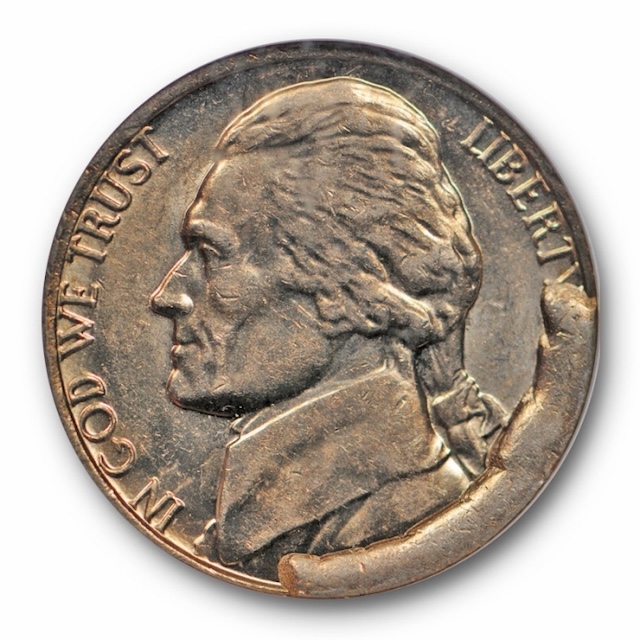
A die cud is the most severe form of die crack error. It occurs when a section of the die face actually breaks away entirely, leaving a void that fills with planchet metal during the strike. The result is a raised, rounded blob of metal at the coin's rim — shapeless and distinctly unintended — directly connected to the rim itself. Unlike a simple die crack (which produces a raised line), a cud is a full three-dimensional raised mass.
On 2001 nickels, die cuds appear most often at the rim on either the obverse or reverse. The coin struck with a broken die segment shows a blank, raised lump where the missing die portion would have impressed the design. The surrounding design elements remain intact, making the contrast especially stark. A 2001-P MS68 specimen with multiple die breaks is among the more dramatic documented examples from this year.
Collectors prize cud errors because they represent a terminal die state — the die was effectively destroyed before striking ended. Each cud coin is unique in exact placement and size, as the die break evolves with each subsequent strike. The rarity of documented cud examples on 2001 nickels in high Mint State grades makes these among the hardest error types to acquire for this date.
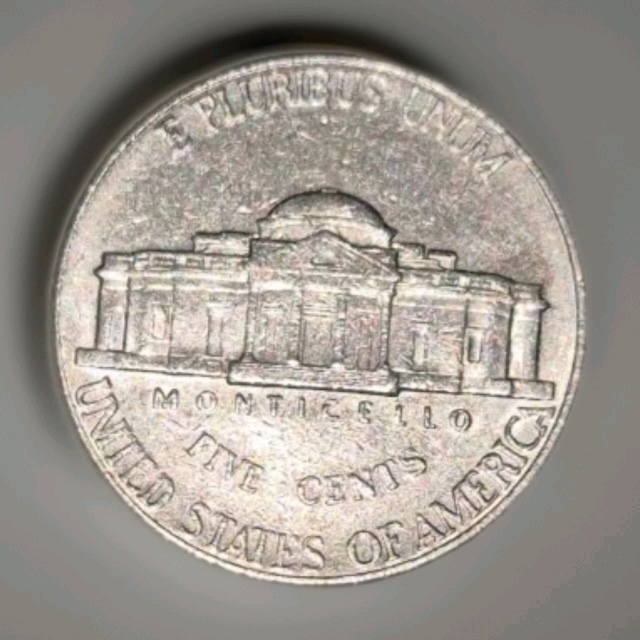
A partial collar error, also called a "railroad rim" error, occurs when the planchet is only partially seated inside the retaining collar during the moment of striking. The portion of the coin inside the collar is properly contained and produces a normal-looking edge, while the portion outside the collar spreads outward under the strike pressure, creating a distinctive raised ridge or beveled flange along part of the coin's circumference.
On 2001 Jefferson nickels, partial collar strikes produce coins that appear slightly wider or asymmetrical when viewed from the side. The edge shows a clear transition zone — normal smooth edge on the portion seated in the collar, and a raised, spread-out bevel on the unsupported section. The obverse and reverse design fields typically remain intact and readable, making these errors both numismatically significant and visually dramatic.
The 2001-D Denver issue has produced particularly desirable partial collar examples. A 2001-D graded MS67 with a partial collar error reportedly realized approximately $870 at an eBay auction in 2006, reflecting the strong collector demand for this error type. Denver's compressed grade curve means any MS67 Denver nickel is inherently scarcer, and the added error designation amplifies premium significantly at that grade level.
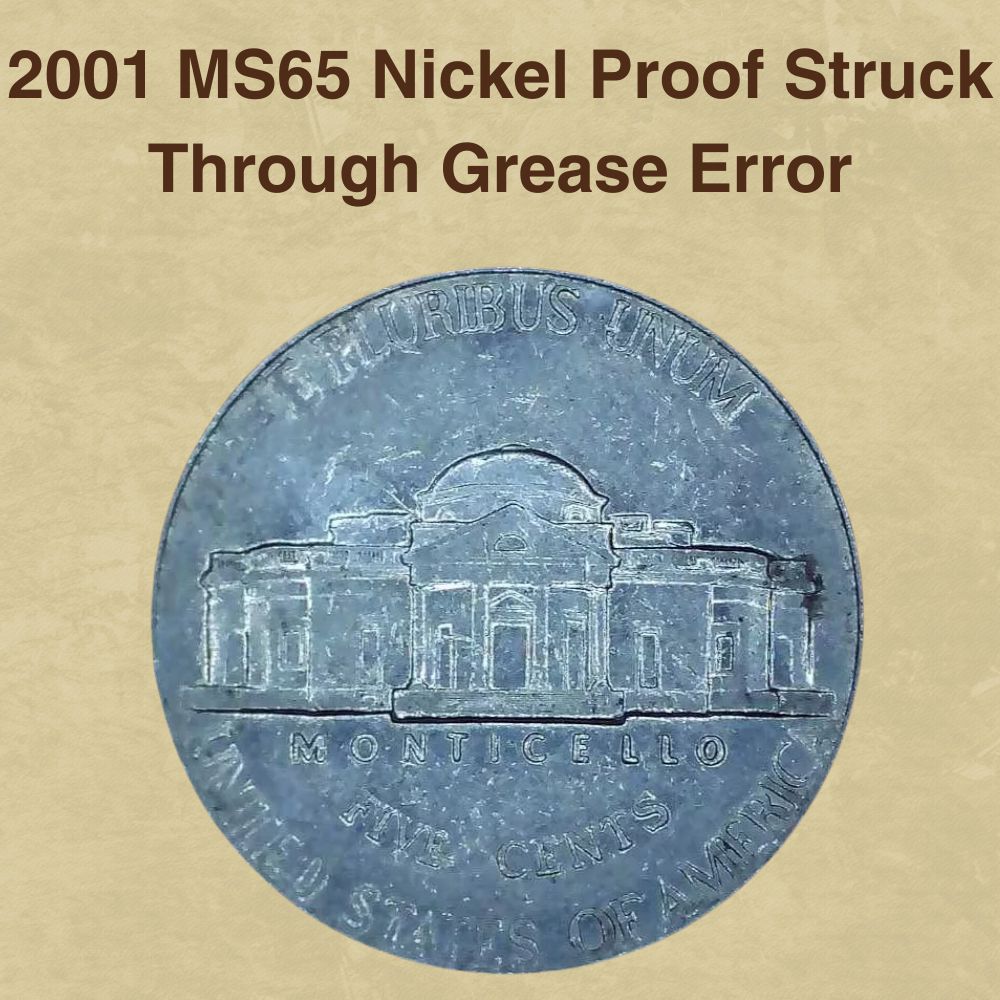
A struck-through grease error occurs when die lubricant or foreign material accumulates in the recesses of a die and is not cleared before striking. When the contaminated die strikes the planchet, the lubricant acts as a physical barrier, preventing the planchet metal from fully flowing into the die cavity. The result is a coin where affected areas appear soft, incomplete, or entirely blank — as though the design simply faded away in those spots.
On 2001 nickels, grease errors are most visually obvious when they affect lettering or the portrait. A coin showing "IN GOD WE TRU" with the final "ST" missing, or Jefferson's features appearing flat and undefined in a localized zone while the surrounding design is sharp, is a classic example of this error type. An MS65 proof struck-through grease specimen has been documented in the 2001 series, showing how even the carefully controlled San Francisco proof process was not immune to this error.
The collectibility of grease errors scales directly with the extent of the affected area and whether key design elements — letters, dates, or the portrait — are visibly impacted. A coin missing a complete letter or showing a large blank zone where design elements should appear commands the strongest premiums. Lighter examples with minimal grease effect have modest value, while dramatic examples with major missing design elements attract serious collectors.
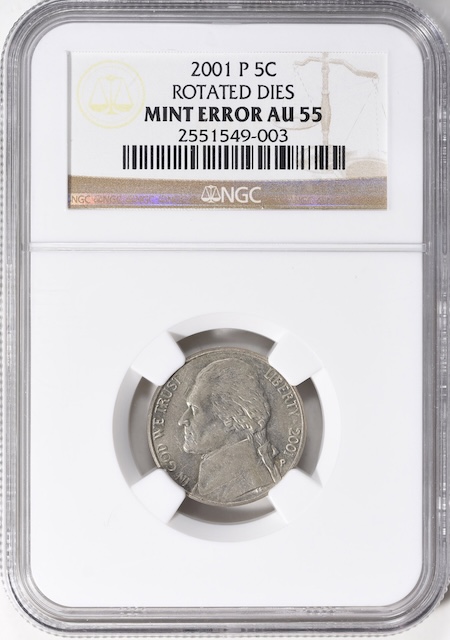
A rotated die error results when the obverse and reverse dies are not properly aligned at the standard 180-degree coin-turn orientation. On a normal U.S. coin, turning the coin on its vertical axis should bring the reverse perfectly upright. When a die has rotated from its proper position, the reverse appears tilted at an angle — anything from a slight few degrees to a full 90- or even 180-degree rotation in the most extreme cases.
On 2001 Jefferson nickels, a D (Denver) MS65 reverse rotated die error has been documented in the collector literature. The rotation is measured in degrees from the expected 180° orientation. Minor rotations of 15–30 degrees are interesting but command modest premiums; more dramatic rotations of 45° or greater are where collector interest sharpens considerably. A 90° or 180° rotation effectively turns Monticello upside-down relative to Jefferson's portrait, creating a dramatically wrong-looking coin that immediately catches the eye.
Rotated die errors occur when the die lock nut fails to hold the die firmly in its seat during the striking process, allowing the die to rotate incrementally. Unlike many errors that affect only the coin's surface, a rotated die affects every coin struck from that pairing until the problem is corrected — meaning multiple coins from one die pairing may share the same rotation angle, which can be useful for attribution purposes.
Run it through the calculator to see what your 2001 nickel error coin might be worth — select your mint mark, grade, and the matching error type.
| Mint | Mint Mark | Type | Mintage | Notes |
|---|---|---|---|---|
| Philadelphia | P | Circulation Strike | 675,704,000 | Common in all grades; FS scarcity begins at MS67+ |
| Denver | D | Circulation Strike | 627,680,000 | FS scarcity begins at MS66; holds all-time value record |
| San Francisco | S | Proof Only | 3,184,606 | Sold in collector proof sets; DCAM grade most sought |
| Total | ~1,306,568,606 | Combined P + D + S production | ||
Jefferson's portrait shows significant flatness on the cheek and across the hair strands above the ear. Monticello's dome and columns are visible but flat, and the steps have completely merged together. All lettering remains readable. Value: $0.15 for most examples — essentially face value.
Light wear traces appear on Jefferson's cheek and on the highest point of Monticello's dome. The coin still has significant original mint luster in the protected recesses. Step lines may be partially visible but not sharp enough to qualify as Full Steps. Value: $0.60–$0.90 for most examples.
No wear whatsoever — original mint luster covers the entire surface. Jefferson's portrait is fully sharp. Contact marks from bag-handling are normal at MS60–63; MS64–65 examples show only minor marks in non-focal areas. Steps may be soft but no circulation wear. Value: $1–$41 (standard), up to $100 with Full Steps.
Exceptional luster, virtually no contact marks, and sharp design throughout. The Full Steps designation requires 5–6 completely unbroken step lines on Monticello under 10× magnification. True MS66+ FS examples are conditionally scarce for both mints. Value: $41–$823+ depending on mint mark, grade, and FS designation.
📱 CoinKnow can photograph your coin and match its surface and step details against graded reference examples — a coin identifier and value app that helps you estimate condition before deciding whether to submit for professional grading.
The right selling venue depends on your coin's grade and whether it has the Full Steps designation or an error variety. Here are the four best options.
The best choice for certified 2001-D or 2001-P Full Steps examples in MS66 or higher, or for dramatic error coins. Heritage holds the record sale of $823 for this date. Consignment minimums apply — best for coins with clear market value above $100.
Ideal for mid-range certified examples (MS64–MS66 FS) and interesting error coins where you want competitive bidding. Check recently sold prices for 2001-D nickels on completed eBay listings to calibrate your starting bid. Raw (uncertified) coins also sell well here if clearly photographed and accurately described.
Convenient for circulated examples and low-grade mint state coins where postage and auction fees would eat your profit. Expect 60–70% of retail value — dealers need their margin. Good for quick cash on bulk coins or partial rolls of 2001 nickels.
Active community of collector-to-collector sales with no listing fees. Great for raw uncirculated examples with Full Steps potential — knowledgeable buyers here will recognize step quality. Post clear macro photos with good lighting. Builds reputation over multiple sales.
Professional grading by PCGS or NGC makes sense for a 2001 nickel only if it shows clear Full Steps characteristics at MS65 or higher, or if it has a significant mint error. Grading fees typically start around $25–$40 per coin. For a 2001-P FS MS65 worth $10–$20, grading costs more than the coin's certified value. For a 2001-D that shows strong Full Steps at MS66+, where certified examples sell for $100–$400+, certification dramatically increases buyer confidence and realized price.
The calculator takes under 30 seconds — just pick your mint mark, condition, and any errors you've spotted.
Calculate My 2001 Nickel Value →